| Author | Message | ||
| Mats W (Kålroten)
|
Hungry snakes. This is a good game, but I suggest that you move the whole snake using cascade, beginning from the head. This is the way to move such "multiple-pieces". Simply capturing the segments of the snake is not attractive graphically. Mats | ||
| Mats W (Kålroten)
|
The theme of the two devouring snakes is frequently depicted in alchemy. Alternatively, two dragons fight each other, one wingless and one winged. Or a winged dragon is fighting a lion. Sometimes it's a dog fighting a wolf. Here are some examples: In this picture from Flamel a serpent devours another.  A winged dragon fighting a serpent, from Eleazar. 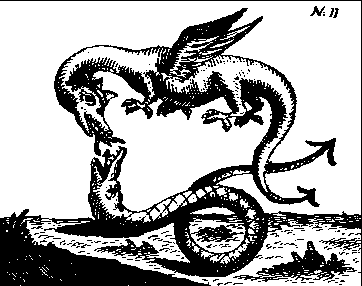 Here the two devouring serpents form an "uroboros" (from Eleazar). 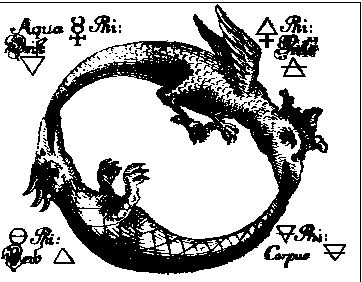 A wolf and dog fighting, from Atalanta Fugiens. 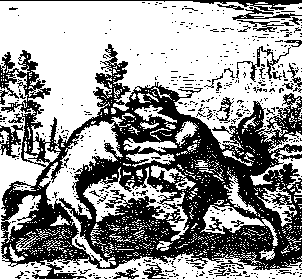 Typically, this fight is going on in the alchemical flask. The outcome of the process, if it's going to succeed, is that one snake shall devour the other. Typically, the winged dragon is devoured. Or the Corax (the raven) defeats the blue, heavenly, bird. These two encoiling snakes are extant on the Cadeus, the staff of Mercury, which is the sign of doctors until today. On a superficial level it could be understood as the fight for supremacy of two competing powers in the psyche. One is the daily vibrant energy which makes us engage in our daily doings, almost frantically sometimes. But there is another energy, associated with the moon, the wingless dragon, the green lion, which devours the sun. | ||
| Karl Scherer (Karl)
|
"I suggest that you move the whole snake using cascade, beginning from the head. This is the way to move such multiple-pieces." I doubt it. (It's much more programming, by the way). But please feel free to go ahead, make the changes you suggest and send me the result to convince me. Cheers, Karl | ||
| Mats W (Kålroten)
|
Why is it harder to simply move the segment instead of removing it and then inserting a new in the movement direction? The latter is more complicated, I would say. | ||
| Mats W (Kålroten)
|
Moving a multiple-piece of four segments to the east: (1) e cascade w w from e cascade w w from e cascade w w from e add Why is the above more difficult than the capturing method? | ||
| Karl Scherer (Karl)
|
If it is so simple, why have I not received the zrf with your changes?????? I am still waiting for your zrf. Actions are worth more than a thousand words. Cheers, Karl :-) | ||
| Karl Scherer (Karl)
|
To answer your question: the snakes can have any lengths and do have many 90-degree turns. The code is quite complicated already. So I suggest (for the last time) you show that what you say is true by sending me the zrf instead of arguing about what you have not even tried. Good luck. | ||
| Mats W (Kålroten)
|
I am very disappointed that you cannot solve this problem. Mats | ||
| M Winther (Kalroten)
New member Username: Kalroten Post Number: 42 Registered: 1-2007 |
Karl, the problem took me a minute to fix. I defined a piece (piece (name invisible-piece) (dummy)) and before the capture of the tail piece I simply make (change-type invisible-piece). In this way we don't need to see the snake pieces fly over the screen. However, the code is so heavy and it doesn't attempt to play good. So the game is no challenge. /Mats |